
Bitcoin’s Monthly Chart Surprises With Rare Indecision

 Bitcoin's monthly chart has recently exhibited a rare pattern marked by significant market indecision. The October candlestick presented an enormous price range between $103,600 and $126,000, catching both bulls and bears off guard. However, the month closed with a modest decline of only 3.8%. This wide price movement followed by a close near the month's opening price has been referred to as an "indecision candlestick" among analysts.

Is Bitcoin Gathering Strength or Losing Momentum?

Some analysts view Bitcoin's current outlook as a potential bottom formation process. Since the start of 2023, the largest cryptocurrency has shown a gradual uptrend, differing from past sharp peak formations. Historically, Bitcoin peaks have often ended with sharp and short-lived rises, but now the situation may indicate a calm accumulation of strength. However, the element of indecision complicates the picture. This indecision is evident at the critical trendline combining the all-time highs of 2017 and 2021. Despite expectations of dominant buyers at these levels, market hesitation is significant.
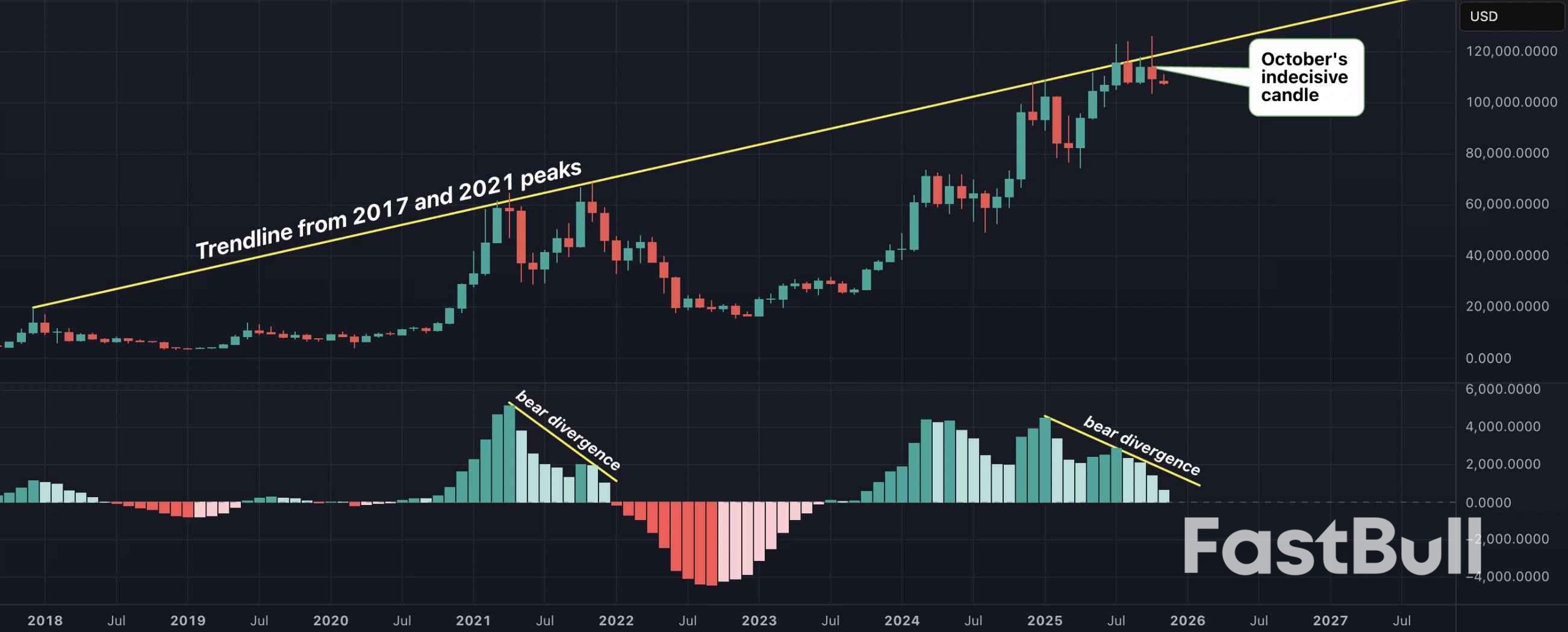
Additionally, the monthly MACD indicator's histogram reveals a weakening of bullish momentum. As the indicator reduces peaks above the zero line, it suggests a decrease in upward momentum. The new price peak seen in October was not confirmed by the MACD, recalling the warnings from the 2021 peak divergence.

Persistent Uncertainty Despite Macro Support

The uncertain portrayal of Bitcoin is further highlighted by global developments. The interest rate cuts by the Federal Reserve and improving trade relations between Washington and Beijing would typically boost risk appetite. However, investors' cautious stance has weakened bullish expectations. Meanwhile, signals of recovery from the prolonged decline in the US Dollar Index (DXY) are increasing pressure on Bitcoin. Past instances of DXY strengthening have resulted in selling pressure across the cryptocurrency market.

The technical outlook suggests a weak scenario for an upward trend unless Bitcoin surpasses $116,000. Otherwise, the likelihood of a price pullback towards $100,000 is strengthening. Analysts agree that for the rising trend to continue, buyers need to regain control.

Source: CryptoSlate

Risk Warnings and Disclaimers
You understand and acknowledge that there is a high degree of risk involved in trading. Following any strategies or investment methods may lead to potential losses. The content on the site is provided by our contributors and analysts for information purposes only. You are solely responsible for determining whether any trading assets, securities, strategy, or any other product is suitable for investing based on your own investment objectives and financial situation.
Add to Favorites
Share

Asia's Factories Stumble As US Tariffs Hit Order Books

Nov 03 18:00:11

Asia's big manufacturing hubs struggled to fire up in October, business surveys showed on Monday, as weak U.S. demand and tariffs under President Donald Trump hit factory orders across the region.

While Trump's visit to Asia last week led to some progress in trade negotiations with large manufacturing economies such as China and South Korea, exporters continue to be cautious about U.S. demand.

Private-sector purchasing managers' indexes (PMIs) for October released on Monday showed manufacturing activity growing at a slower pace in China and falling in South Korea, with export orders in both countries declining.

Friday's official PMI survey showed China's factory activity falling for the seventh straight month, confirming suspicions that the earlier export rush to get ahead of U.S. tariffs had well and truly ended.

"The PMIs suggest that China's economy lost some momentum in October, with slower growth across manufacturing and construction," said Zichun Huang, China economist at Capital Economics. "Some of this weakness may reverse in the near term, but any boost to exports from the latest U.S.-China trade 'deal' is likely to be modest and wider headwinds to growth will persist."

CAUTIOUS OPTIMISM ON TARIFFS PROGRESS

In a meeting in South Korea last week, Trump and Chinese President Xi Jinping agreed to de-escalate tensions, including through a one-year delay in reciprocal tariffs, but the agreement does little to address a deeper divide between the two superpowers.

Policymakers in Beijing are looking to see whether China's $19 trillion economy is on track to hit its official 2025 growth target of around 5%, without needing to reach for further stimulus.

Trade data for September showed China's exports rising faster-than-expected, although this was mostly due to growth in new markets as U.S.-bound shipments tumbled 27% year-on-year.

Similarly, Seoul's trade deal with Trump announced last week secured lower U.S. tariffs on Korean goods, but was seen at best as a compromise that prevents Asia's fourth-largest economy from falling behind in global trade.

Elsewhere in Asia, continued declines were also seen in factory activity in Malaysia and Taiwan, PMIs showed, although Vietnam and Indonesia saw growth in their manufacturing sectors pick up.

Source: Yahoo Finance

To stay updated on all economic events of today, please check out our Economic calendar
Risk Warnings and Disclaimers
You understand and acknowledge that there is a high degree of risk involved in trading. Following any strategies or investment methods may lead to potential losses. The content on the site is provided by our contributors and analysts for information purposes only. You are solely responsible for determining whether any trading assets, securities, strategy, or any other product is suitable for investing based on your own investment objectives and financial situation.

Post a Comment

0 Comments
